Social Entrepreneur vs Entrepreneur: What's the Difference?
What is the difference between a social entrepreneur and an entrepreneur?
At first glance, the answer might seem simple.
An entrepreneur builds a business.
A social entrepreneur builds a business that aims to create positive social or environmental impact.
But the real difference goes deeper than that.
Both can identify opportunities, create products and services, take risks, build teams, attract customers and generate profit. The fundamental difference is often found in what the business is ultimately trying to achieve and how it creates value.
A conventional entrepreneur may primarily pursue a commercial opportunity.
A social entrepreneur deliberately places a social, environmental or community problem at the heart of the entrepreneurial opportunity.
And there is an important point that is sometimes misunderstood:
A social entrepreneur can make a profit.
In fact, financial sustainability can help a social enterprise continue creating impact over the long term. Academic research and current educational sources recognise that social entrepreneurship can operate through different models, including for-profit, nonprofit and hybrid approaches.
This is where the idea of profit with purpose becomes important.
Social Entrepreneur vs Entrepreneur: The Simple Difference
The simplest way to understand the difference is to look at the type of value being created.
Entrepreneur
An entrepreneur identifies an opportunity and builds a business around creating and capturing commercial value.
The business may exist to:
Solve a customer problem
Create a new product
Provide a service
Enter a new market
Build wealth
Create employment
Grow a company
Generate a return for its owners or investors
Social Entrepreneur
A social entrepreneur does many of the same things but deliberately incorporates social, environmental or community value into the purpose of the venture.
The business may exist to:
Address a social problem
Improve access to opportunity
Support disadvantaged communities
Create employment or education opportunities
Improve environmental outcomes
Strengthen local communities
Develop solutions to unmet social needs
Generate both economic and social value
Research comparing commercial and social entrepreneurship commonly identifies the social entrepreneur’s stronger orientation toward societal goals, while recognising that both forms share entrepreneurial characteristics such as opportunity recognition, innovation and risk-taking.
Is a Social Entrepreneur Still an Entrepreneur?
Absolutely.
A social entrepreneur is still an entrepreneur.
They still have to understand customers.
They still have to develop a viable product or service.
They still have to manage money.
They still have to market and sell.
They still have to compete.
They still have to deal with uncertainty.
They still have to make difficult decisions.
The difference is that a social entrepreneur deliberately considers social value alongside economic value.
Think of it this way:
Entrepreneurship asks:
What opportunity can I turn into a successful business?
Social entrepreneurship asks:
What problem can I help solve, and can I build a sustainable business around solving it?
That difference in starting point can fundamentally change the business that emerges.
What Is Social Entrepreneurship?
Social entrepreneurship is the process of using entrepreneurial thinking, innovation and business models to address social, environmental or community problems.
It isn’t restricted to one particular type of company.
A social enterprise might be a commercial company, a nonprofit with trading activities, a cooperative, a hybrid organisation or another structure appropriate to its mission and circumstances. Social entrepreneurship is therefore better understood as an approach to creating value rather than simply a legal business category.
At its heart is a simple idea:
Use entrepreneurial capability to create positive change.
Profit vs Purpose: Do Social Entrepreneurs Make Money?
This is one of the biggest misconceptions about social entrepreneurship.
Some people believe that if a business makes a profit, it cannot be a social enterprise.
That isn’t necessarily true.
Social enterprises can use revenue and profit to sustain and expand their activities. Some models are commercially profitable, while others combine trading income with grants, donations or other funding.
The important question isn’t simply:
Does the business make money?
The more useful question is:
What role does profit play in the business?
For a purpose-driven entrepreneur, profit can provide the financial engine that keeps the mission alive.
That is the philosophy behind profit with purpose.
Profit gives the business the ability to survive and grow. Purpose gives it a reason to exist.
This is an important distinction.
A social entrepreneur doesn’t necessarily reject profit.
They reject the idea that profit has to be the only measure of success.
The Key Differences Between a Social Entrepreneur and an Entrepreneur
| Entrepreneur | Social Entrepreneur |
|---|---|
| Primarily identifies a commercial opportunity | Identifies a social, environmental or community opportunity |
| Commercial value is central | Commercial and social value are considered |
| Profit may be the primary measure of success | Profit and social impact can both be measured |
| Customers are primarily viewed as a market | Customers can also be part of a wider impact ecosystem |
| Success may be measured financially | Success can include financial and social outcomes |
| May address social issues indirectly | Social impact is deliberately connected to the mission |
This isn’t a rigid rule.
There is a broad spectrum between conventional entrepreneurship and social entrepreneurship.
Many businesses sit somewhere in the middle.
What Do Entrepreneurs and Social Entrepreneurs Have in Common?
The similarities are often overlooked.
Both entrepreneurs and social entrepreneurs need many of the same skills.
Opportunity Recognition
Both need to identify opportunities that others may not see.
Innovation
Both may develop new products, services, technologies or business models.
Risk-Taking
Neither can predict the future with certainty.
Sales and Marketing
A brilliant idea still needs customers.
Financial Management
Revenue, costs, cash flow and sustainability matter to both.
Leadership
Both need to attract people who believe in the opportunity.
Resilience
Businesses rarely develop exactly as originally planned.
The social entrepreneur therefore isn’t a completely different type of person.
They are often using the same entrepreneurial toolkit with a broader definition of value.
What Makes Someone a Social Entrepreneur?
A person doesn’t become a social entrepreneur simply by saying that their business is doing good.
The social purpose needs to be meaningful and connected to the way the venture operates.
Ask yourself:
1. What problem am I trying to solve?
Be specific.
“Make the world better” isn’t a business model.
“Help local independent businesses compete and remain connected to their communities” is much more specific.
2. Who benefits?
Identify the people, businesses, communities or environments that are intended to benefit.
3. What is the business solution?
What exactly are you providing?
4. Who pays for it?
This is where entrepreneurship becomes critical.
5. How does the model remain financially sustainable?
A purpose without financial sustainability can struggle to survive.
6. How will you measure impact?
If you want to claim social impact, determine what evidence would demonstrate it.
Traditional Business vs Social Enterprise
Another useful distinction is between a traditional business and a social enterprise.
A traditional business may create positive social outcomes as a by-product of its operations.
For example, a successful company might employ local people, pay suppliers and contribute to the local economy.
That is valuable.
But social entrepreneurship goes further when the social or environmental purpose is deliberately incorporated into the venture’s mission and model.
A business donating to a charity once a year doesn’t automatically make it a social enterprise.
Corporate social responsibility and social entrepreneurship can overlap, but they aren’t necessarily the same thing. Current research and educational sources distinguish social entrepreneurship from simply adding charitable or responsible activities to an otherwise conventional business.
Can a Normal Entrepreneur Become a Social Entrepreneur?
Yes.
You don’t necessarily have to start again from scratch.
An existing entrepreneur can examine their business and ask:
How could this business create greater value for the people and community around it?
Perhaps you could:
Create employment opportunities
Train people entering the workforce
Support local suppliers
Develop a community programme
Make your products more accessible
Reduce environmental waste
Create opportunities for disadvantaged groups
Share knowledge through mentoring
Reinvest part of the business’s success into community projects
The key is to make the impact intentional, meaningful and sustainable rather than simply adding a marketing message.
Social Entrepreneur or Entrepreneur: Which One Should You Become?
There isn’t a universal answer.
If your primary objective is to identify a commercial opportunity and build a profitable company, traditional entrepreneurship may be the right path.
If you want your business to tackle a social or environmental problem as an integral part of its purpose, social entrepreneurship may be more appropriate.
And there is another possibility.
You don’t necessarily have to choose between them.
You can become an entrepreneur who deliberately builds social value into the business.
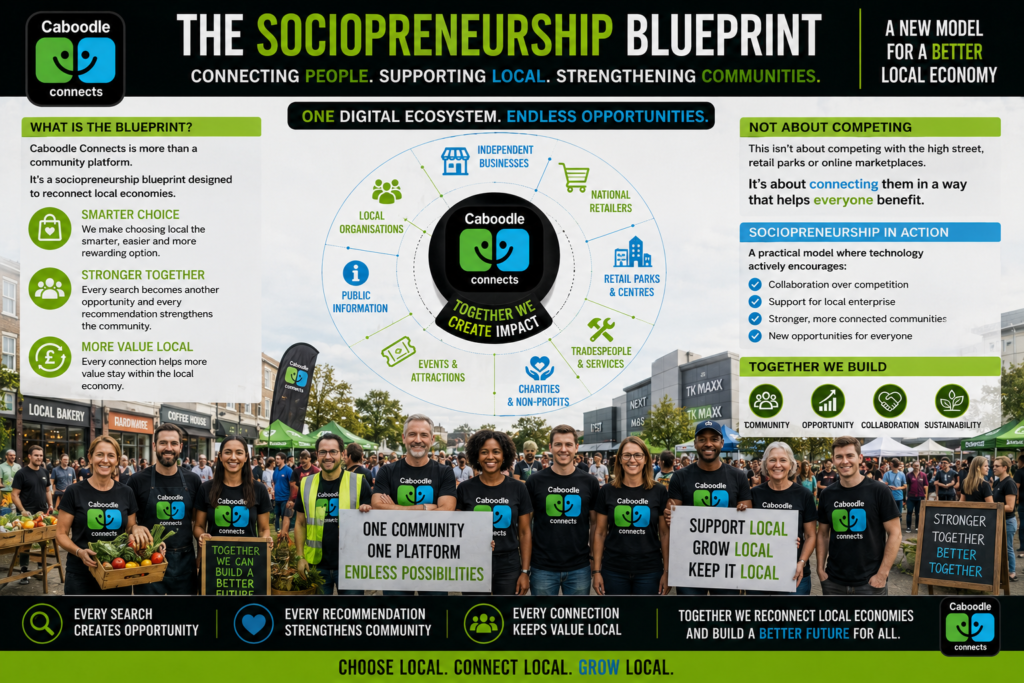
That is the space I call Sociopreneurship.
What Is a Sociopreneur?
I use Sociopreneur to describe an entrepreneur who sees business as a vehicle for both commercial success and positive community impact.
A Sociopreneur doesn’t see:
Profit OR Purpose
They see:
Profit AND Purpose.
The objective is to build a commercially sustainable enterprise while deliberately creating value beyond the transaction.
That might mean supporting local businesses, creating employment, building community networks, improving access to opportunity, funding community projects or developing solutions to problems that traditional markets haven’t solved effectively.
This is the thinking behind The Sociopreneur Method.
It isn’t about abandoning conventional business principles.
It is about expanding the definition of what business success can mean.
The Sociopreneur Method: Three Dimensions of Value
I believe a purpose-driven business can be viewed through three connected dimensions.
1. Commercial Value
Does the business create something people are willing to pay for?
2. Human Value
Does it create genuine value for the people who use, work with or participate in the business?
3. Community Value
Does the business contribute to a stronger community or help address a wider problem?
When these three elements work together, business becomes more than a transaction.
It becomes an ecosystem of value.
Why Social Entrepreneurship Is Becoming More Important
Social entrepreneurship is not simply about creating another type of business.
It reflects a wider question about what businesses are capable of achieving.
Entrepreneurs have always been problem solvers.
The opportunity is to apply that problem-solving ability to some of the challenges that communities and society face.
Research has long described social entrepreneurship as combining entrepreneurial resourcefulness with a mission to create social change. More recent discussions continue to emphasise the challenge of creating both financial sustainability and lasting social impact.
That creates an exciting opportunity for a new generation of entrepreneurs.
Frequently Asked Questions
Is a social entrepreneur the same as an entrepreneur?
A social entrepreneur is an entrepreneur who deliberately pursues social, environmental or community impact alongside entrepreneurial and economic objectives. The two share many skills and activities, but the social entrepreneur places greater emphasis on creating social value.
Can a social entrepreneur make a profit?
Yes. Social enterprises can use commercially viable business models, although social entrepreneurship can also operate through nonprofit or hybrid structures. Profit can provide financial sustainability that allows the organisation to continue pursuing its mission.
What is the difference between social entrepreneurship and entrepreneurship?
The main difference is the role of social or environmental impact in the venture’s purpose and value creation. Traditional entrepreneurship generally focuses primarily on commercial opportunity, while social entrepreneurship deliberately seeks to create social value through entrepreneurial activity.
Can any entrepreneur become a social entrepreneur?
Yes. An entrepreneur can incorporate a meaningful social or environmental objective into an existing business model or develop a new venture specifically around a social problem.
What is a Sociopreneur?
In the framework I use, a Sociopreneur is an entrepreneur who combines commercial sustainability with deliberate social and community value — profit with purpose.
Social Entrepreneur vs Entrepreneur: The Real Difference
Ultimately, the difference isn’t simply about whether someone makes money.
It’s about what they believe business is capable of achieving.
An entrepreneur might ask:
How can I build a successful business?
A social entrepreneur might ask:
How can I use business to solve a problem?
A Sociopreneur asks:
How can I build a successful business that solves a problem, creates opportunity and strengthens the community around it?
That is the philosophy behind profit with purpose.
And that is why I believe the future of entrepreneurship doesn’t have to be about choosing between commercial success and social impact.
We can build businesses that do both.
Continue Your Sociopreneur Journey
Ready to go deeper?
Learn how to become a social entrepreneur →
Explore the complete guide to identifying a problem, developing a sustainable business model, measuring impact and building a business around profit with purpose.
Next: How to Start a Social Enterprise →
Discover how to turn a social or community problem into a commercially sustainable enterprise.
Explore Social Entrepreneurship Business Ideas →
Discover practical business opportunities where commercial value and positive social impact can work together.