How To Start A Social Enterprise
How to Start a Social Enterprise: A Practical Guide to Profit With Purpose
What if you could build a business that generates an income while helping solve a problem in your community?
That’s the opportunity at the heart of a social enterprise.
Starting a social enterprise is not simply about having a good cause. It is about turning a meaningful social, environmental or community problem into a sustainable business model that can create measurable impact and continue operating over the long term.
That means thinking like an entrepreneur while keeping your purpose at the centre of the business.
In simple terms:
Find a problem. Create a solution. Build a business around it. Measure the impact.
And importantly, don’t be afraid of the word profit.
A financially sustainable social enterprise has a greater ability to survive, employ people, grow its solution and increase its impact.
This is the philosophy I call profit with purpose.
What Is a Social Enterprise?
A social enterprise is a business or organisation that uses entrepreneurial activity to pursue a defined social, environmental or community purpose.
Unlike a conventional business whose primary objective may be commercial return to owners or shareholders, a social enterprise places its mission at the centre of its business activity.
Different countries and organisations use slightly different definitions, and there is no single legal structure that applies to every social enterprise. A social enterprise can operate through a variety of structures depending on its location and objectives.
What matters most is the relationship between:
Purpose → Business Activity → Revenue → Impact
A social enterprise isn’t simply a business that occasionally gives money to charity.
The social or environmental purpose should be meaningfully connected to what the organisation does.
Can a Social Enterprise Make a Profit?
Yes.
This is one of the most important things to understand before starting one.
Social entrepreneurship and profit are not automatically opposites.
A social enterprise can generate income by selling products or services, just like other businesses. Depending on its structure and mission, profits or surpluses may be reinvested into the business or used to advance its social purpose.
Think about it this way:
Profit provides the fuel. Purpose provides the direction.
Without sufficient income, a social enterprise may struggle to sustain its activities.
Without a clear purpose, it risks becoming simply another commercial business.
The challenge is to build a model where the two reinforce each other.
How to Start a Social Enterprise
Starting a social enterprise follows many of the same entrepreneurial principles as starting any other business.
The difference is that you need to think about social impact and financial sustainability at the same time.
Here are the key steps.
1. Start With a Problem — Not a Business Idea
One of the biggest mistakes aspiring social entrepreneurs can make is starting with the product.
Instead, start with the problem.
Ask:
What problem exists?
Who experiences it?
Why does it exist?
What solutions already exist?
What isn’t working?
What would a better solution look like?
Would people actually use it?
The School for Social Entrepreneurs similarly recommends getting specific about the problem, understanding the people affected and testing assumptions rather than trying to build a perfect solution immediately.
Your objective is not to save the world on day one.
It is to understand one problem deeply enough to build a useful solution.
2. Define Your Social Purpose
Once you’ve identified the problem, define exactly what your social enterprise exists to achieve.
Try completing this sentence:
We exist to help ______ by ______ so that ______.
For example:
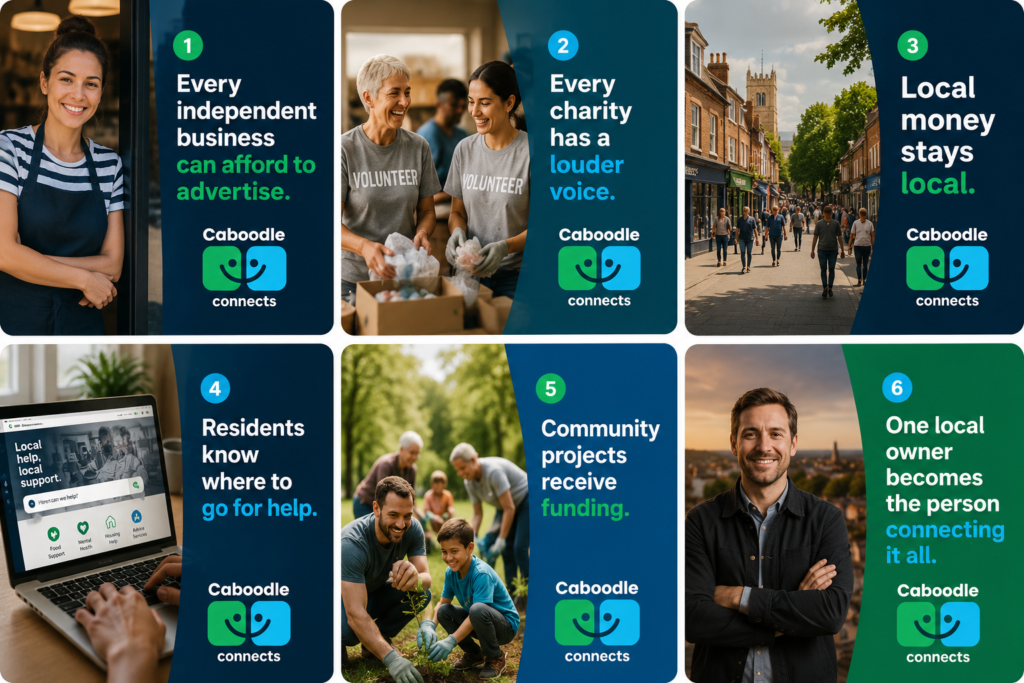
We exist to help independent local businesses by connecting them with customers, resources and community opportunities so that stronger local economies can develop.
That’s far more useful than:
“We want to make a difference.”
Your purpose should be specific enough that you can eventually measure whether you’re achieving it.
3. Identify Who Benefits
A social enterprise may have several different groups involved.
For example:
Customers
The people buying your product or service.
Beneficiaries
The people who experience the intended social benefit.
Community
The wider group affected by your activities.
Partners
Organisations that help you deliver the mission.
Employees
The people working within the enterprise.
These groups may overlap, but they don’t always.
Understanding the difference helps you design a better business model.
4. Talk to the People Experiencing the Problem
Don’t build your social enterprise entirely from behind a computer.
Go and talk to people.
Ask them:
What is the biggest problem you’re facing?
What have you already tried?
What would make the biggest difference?
Would you use this solution?
Would you pay for it?
What would stop you from using it?
The answers may completely change your original idea.
That’s not failure.
That’s entrepreneurship.
The School for Social Entrepreneurs recommends listening to the people you intend to support and testing ideas through small pilots rather than building an entire programme before knowing whether it works.
5. Develop Your Social Enterprise Business Model
Now we reach the commercial heart of your idea.
A social enterprise still needs a business model.
You need to understand:
What do you provide?
Your product or service.
Who receives the value?
Your customer and/or beneficiary.
Who pays?
This is critical.
How much do they pay?
Your pricing.
What does it cost you to deliver?
Your operating costs.
How do you generate sustainable income?
Your revenue model.
How does the model create social impact?
Your impact mechanism.
A business model describes how an organisation creates, delivers and captures value.
For a social enterprise, you need to add another question:
How does the business model create and sustain social value?
6. Choose Your Revenue Model
There isn’t one universal social enterprise business model.
Depending on your idea, you might generate revenue through:
Selling products
Selling services
Subscriptions
Memberships
Licensing
Training
Consulting
Digital products
Marketplace fees
Corporate contracts
Institutional contracts
Sponsorship
A combination of earned income and grants
The important principle is alignment.
Your revenue model shouldn’t undermine your social purpose.
For example, if your purpose is to increase access to an essential service for people on low incomes, a pricing model that makes the service inaccessible to those people may undermine the mission.
Your commercial model and your social purpose need to work together.
7. Build a Minimum Viable Social Enterprise
You don’t necessarily need an office, a large team or a complicated website to begin.
Start small.
Build the simplest version of your solution that allows you to test whether the idea works.
This might be:
One service
One product
One neighbourhood
One community
One customer group
One pilot programme
Then measure what happens.
A small pilot can reveal problems that would otherwise become expensive mistakes.
The School for Social Entrepreneurs recommends testing ideas through small pilots and using evidence to improve the model.
8. Test Whether People Will Pay
This is where a lot of purpose-driven ideas become uncomfortable.
People may love your idea.
They may say it is fantastic.
They may tell you that it is desperately needed.
But will they pay for it?
That’s the question your business needs to answer.
If nobody will pay, you may need:
A different customer
A different price
A different product
A different revenue source
A partnership
Grant funding
A hybrid model
Don’t confuse enthusiasm with demand.
A social enterprise still has to solve a market problem.
9. Measure Your Social Impact
If social impact is part of your business purpose, you need a way of demonstrating it.
Your measurements might include:
People employed
People trained
Businesses supported
Young people helped
Community projects funded
Waste reduced
Local suppliers supported
Income generated for disadvantaged groups
Access created
Skills developed
Community participation increased
You don’t need hundreds of metrics.
Start with a few meaningful ones.
Ask:
What would success look like if our social enterprise is actually working?
Then measure it.
10. Choose the Right Legal Structure
This is an important step, but it is also one where you should avoid assuming that every social enterprise needs the same structure.
There is no single legal form for a social enterprise. Depending on the country, options can include conventional companies, cooperatives, community-interest structures, nonprofit organisations and other forms.
Your choice can affect:
Ownership
Governance
Tax
Investment
Profit distribution
Reporting
Liability
Eligibility for certain funding
Therefore, once your business model is clear, obtain appropriate local legal and accounting advice before choosing your structure.
Purpose comes first. Structure should support the purpose.
11. Build Your Brand Around the Mission
Your brand is more than a logo.
A social enterprise needs to communicate:
What problem are you solving?
Who are you helping?
Why should people trust you?
What makes your solution different?
What impact are you creating?
But be careful about making vague claims.
Don’t simply say:
“We are changing the world.”
Show people what you actually do.
Specificity builds credibility.
12. Build a Community Around the Business
This is where social entrepreneurship becomes particularly powerful.
A social enterprise doesn’t have to operate alone.
You can build relationships with:
Local businesses
Community organisations
Charities
Schools
Universities
Local government
Customers
Volunteers
Mentors
Investors
Other entrepreneurs
These relationships can create an ecosystem around your mission.
And in local social entrepreneurship, that can be especially important.
A business doesn’t exist in isolation.
It exists within a community.
What Are Some Social Enterprise Business Ideas?
Social enterprises can operate in almost any industry.
Examples include:
Employment and Skills
Businesses providing training, apprenticeships or employment opportunities for people facing barriers to work.
Education
Businesses increasing access to training, mentoring or educational resources.
Local Business Support
Platforms and services helping independent businesses reach customers, collaborate and strengthen their local economies.
Sustainability
Businesses focused on recycling, reuse, renewable solutions or reducing waste.
Community Services
Businesses providing services that address unmet local needs.
Technology
Digital platforms that improve access, participation or opportunity.
Affordable Products and Services
Businesses developing commercially sustainable ways to make essential services more accessible.
Social Marketplaces
Platforms connecting customers, businesses, charities, community groups or local producers.
The opportunity is enormous because social problems exist across almost every sector.
Can You Start a Social Enterprise With No Money?
You may be able to start with very little capital, particularly if your business is based around knowledge, services, digital products or partnerships.
For example, you could begin with:
Your professional skills
Consulting
Mentoring
Training
A digital product
A membership community
A service business
A marketplace
A simple online platform
The important thing is to match your starting model to your available resources.
Don’t build an expensive version of a business before proving that people want it.
Start with what you have. Test. Learn. Improve. Grow.
Common Mistakes When Starting a Social Enterprise
Trying to Solve Everything
Choose a specific problem.
Building Before Testing
Don’t spend months developing something nobody wants.
Confusing Purpose With a Business Model
A mission isn’t a revenue model.
Ignoring Pricing
Purpose doesn’t pay the bills by itself.
Measuring Everything
Measure what actually tells you whether the mission is working.
Losing Sight of the Mission
Commercial opportunities can sometimes pull an organisation away from its original purpose.
Use your mission as a filter.
Ask:
Does this opportunity strengthen or weaken our purpose?
The Double Bottom Line
One useful way of thinking about a social enterprise is through the concept of a double bottom line.
Traditional businesses often focus heavily on financial performance.
Social enterprises can look at two connected outcomes:
Financial Sustainability
Is the business financially healthy enough to survive and grow?
Social Impact
Is the business creating the positive change it exists to achieve?
Some organisations expand this further into a triple bottom line, considering economic, social and environmental outcomes.
The important thing is to recognise that financial sustainability and social impact don’t have to be enemies.
They can reinforce each other.
Profit With Purpose
This is where my own approach to social entrepreneurship begins.
I believe we should stop treating profit and purpose as opposites.
A business needs money to survive.
It needs customers.
It needs revenue.
It needs cash flow.
It needs a sustainable model.
But what if that commercial engine could also create positive change?
What if every successful customer transaction helped strengthen a community?
What if business growth created more opportunity?
What if part of the value created by commerce could be channelled back into the community?
That’s the idea behind profit with purpose.
And it is central to the Sociopreneur approach.
What Is a Sociopreneur?
I use the term Sociopreneur to describe an entrepreneur who deliberately combines commercial sustainability with social and community value.
A Sociopreneur doesn’t ask:
Profit or purpose?
They ask:
How can profit help create purpose-driven impact?
This is the philosophy behind The Sociopreneur Method.
The business still has to work.
Customers still need value.
Revenue still matters.
But success is measured more broadly.
Commercial value + human value + community value.
That is the foundation of the Sociopreneur mindset.
A Simple Social Enterprise Formula
If you’re starting from scratch, begin here:
PROBLEM
↓
Identify a genuine social, environmental or community problem.
PEOPLE
↓
Understand who experiences the problem.
SOLUTION
↓
Create something that genuinely helps.
BUSINESS MODEL
↓
Determine who pays and how the enterprise generates sustainable income.
IMPACT
↓
Measure the difference your solution makes.
GROWTH
↓
Scale the business only when the model works.
This is how purpose becomes a business rather than simply an idea.
Your First Social Enterprise Doesn’t Have to Be Perfect
One of the biggest barriers to becoming a social entrepreneur is believing that you need the complete answer before you start.
You don’t.
Your first version will probably change.
Your customers will teach you things.
Your community will challenge your assumptions.
Your business model will evolve.
Your purpose may become clearer.
That’s normal.
The goal isn’t to create the perfect social enterprise on day one.
The goal is to create something useful, sustainable and capable of improving over time.
Frequently Asked Questions About Starting a Social Enterprise
How do I start a social enterprise?
Start by identifying a specific social, environmental or community problem, understand the people affected, develop a solution, create a sustainable revenue model, test it on a small scale, measure the impact and then choose an appropriate legal structure for your country and circumstances.
Can a social enterprise be profitable?
Yes. Social enterprises can generate income through trading and other revenue models. Depending on the structure and mission, profits or surpluses may be reinvested into the enterprise or its social purpose.
Do I need to register as a social enterprise?
Not necessarily. “Social enterprise” describes a way of operating and pursuing purpose rather than one universal legal structure. The appropriate structure depends on the country, ownership model, activities and objectives of the organisation.
What is the difference between a social enterprise and a charity?
A charity generally exists primarily to pursue a charitable purpose, while a social enterprise typically uses trading and entrepreneurial activity as an important part of how it operates and creates impact. There can be overlap, and some charities operate social enterprises.
Can I start a social enterprise by myself?
Yes. A social enterprise can begin with one founder and grow over time. You can start by testing a small version of your idea before building a larger team or organisation.
What makes a social enterprise successful?
A successful social enterprise needs both a meaningful mission and a viable business model. It must create value that customers or other revenue sources support while producing measurable progress toward its social or environmental purpose.
Ready to Start Your Social Enterprise?
You don’t need a huge organisation.
You don’t need a perfect business plan.
And you don’t necessarily need a large amount of capital.
Start with a problem.
Find the people affected by it.
Listen.
Create a solution.
Test whether it works.
Build a business model around it.
Measure your impact.
Then grow.
That’s how an idea becomes an enterprise.
And when that enterprise combines commercial sustainability with social impact, you have something more powerful than a business built purely for profit.
You have profit with purpose.
You are beginning the journey from entrepreneur to Sociopreneur.
Continue Your Sociopreneur Journey
Learn how to become a social entrepreneur →
Return to the complete guide covering the mindset, skills and practical steps involved in becoming a social entrepreneur.
Social Entrepreneur vs Entrepreneur →
Explore the differences between traditional entrepreneurship and social entrepreneurship — and why profit and purpose don’t have to be opposites.
Examples of Successful Social Entrepreneurs →
Discover examples of entrepreneurs who have built ventures around meaningful social and environmental challenges.
Social Entrepreneurship Business Ideas →
Explore practical business ideas that could combine commercial opportunity with positive community impact.