“What is a Social Entrepreneur”
Build a Business with Profit and Purpose
My journey into sociopreneurship began back in the 1980s. I didn’t know it at the time, but it became the foundation for learning how to become a social entrepreneur long before the term became widely recognised.
Looking back across more than four decades of building businesses across 20 industries, one lesson became impossible to ignore: the strongest businesses don’t simply make money. They create opportunities, solve problems and can leave the communities they serve stronger than they found them.
That realisation eventually became the foundation of Caboodle Connects and the philosophy I call The Sociopreneur Method — building commercially sustainable businesses that combine profit with purpose.
If you’ve ever wondered whether you can build a successful business while making a meaningful difference, the answer is yes.
You don’t have to choose between making money and making an impact.
You can build both.
THE SOCIOPRENEUR DEFINITION
A Sociopreneur is a business builder who combines commercial sustainability with a deliberate social or community purpose — creating value for customers while also creating positive impact for people and communities.
What Is a Social Entrepreneur?
A social entrepreneur is someone who identifies a social, environmental or community problem and develops an entrepreneurial solution to address it.
Unlike a traditional business that may primarily measure success through revenue and profit, a social entrepreneur looks at two dimensions of success:
Commercial sustainability — Can the business generate enough revenue to survive, grow and provide a return?
Social impact — Is the business genuinely helping to solve the problem it was created to address?
Social entrepreneurship therefore sits at the intersection of business and social impact.
The goal isn’t simply to create a charity.
It is to create a sustainable enterprise where the business model itself helps support the mission.
That distinction is important.
A social entrepreneur can make a profit.
In fact, sustainable profit can be essential because without financial sustainability, a business may struggle to continue creating its intended impact.
What Does “Profit with Purpose” Mean?
Profit with purpose means building a business where financial success and positive impact work together rather than being treated as opposing objectives.
For example, imagine a business that provides employment and training opportunities for people who traditionally struggle to enter the workforce.
The business still needs customers.
It still needs revenue.
It still needs to control costs.
It still needs to make a profit.
But its purpose goes beyond the transaction.
The business is creating commercial value and social value.
This is the fundamental idea behind the Sociopreneur approach.
Profit pays for sustainability. Purpose gives the business a reason to exist.
Social Entrepreneur vs Traditional Entrepreneur
There is considerable overlap between entrepreneurship and social entrepreneurship.
Both require many of the same fundamental skills:
Identifying opportunities
Understanding customers
Creating products or services
Marketing
Selling
Managing finances
Building relationships
Taking calculated risks
Adapting to changing circumstances
The difference is primarily in the purpose and impact built into the business model.
A traditional entrepreneur may build a business primarily around a commercial opportunity.
A social entrepreneur starts with a commercial opportunity and a social, environmental or community objective.
Neither approach is inherently better.
But if you want your business to contribute to solving a problem beyond your own bottom line, social entrepreneurship provides a framework for doing so.
How to Become a Social Entrepreneur
You don’t need a special qualification to become a social entrepreneur.
You need a problem worth solving, a sustainable way of solving it and the determination to turn the idea into a viable enterprise.
Here are seven practical steps.
1. Find a Problem That Matters
The starting point isn’t necessarily a business idea.
It can be a problem.
Look around you.
What isn’t working?
What frustrates people?
Where are opportunities being missed?
Which groups of people are underserved?
What could be made cheaper, easier, fairer, more accessible or more sustainable?
Some of the best social enterprise ideas begin with someone noticing a problem that everyone else has learned to accept.
Your first question should therefore be:
What problem do I want to help solve?
Not:
What business can I start?
That change in perspective can completely alter the type of opportunity you discover.
2. Understand the People You Want to Help
A social entrepreneur doesn’t simply decide what people need.
They listen.
Talk to potential customers.
Talk to community members.
Talk to organisations already working in the area.
Ask questions.
Find out what the real problem is.
Sometimes the problem you initially identify isn’t the problem people actually want solved.
This is where entrepreneurial research becomes critical.
Your purpose needs to be grounded in reality.
3. Find a Business Model That Can Sustain the Mission
This is where profit with purpose becomes practical.
A good intention isn’t enough to create a sustainable social enterprise.
You need a business model.
Ask:
Who is going to pay?
What are they paying for?
How much will they pay?
What will it cost you to deliver the solution?
Can the business eventually generate a sustainable profit?
A business that continually loses money may have a wonderful mission, but it won’t necessarily have the financial strength required to achieve that mission at scale.
Sustainability matters.
4. Start Small and Test the Idea
You don’t need to build the finished business on day one.
Start with a minimum viable version of your idea.
Test it.
Talk to customers.
Measure what happens.
Learn what works.
Change what doesn’t.
This is particularly important for social entrepreneurs because you are testing two things simultaneously:
Does the commercial model work?
and
Does the solution create the intended impact?
Both need evidence.
5. Measure Your Social Impact
If you claim that your business is creating social value, you should be able to demonstrate it.
Your measurements don’t have to be complicated.
Depending on your business, you might measure:
Jobs created
People trained
Businesses supported
Young people helped
Community projects funded
Waste reduced
Local suppliers supported
Volunteer hours generated
Access improved
Money reinvested into the community
The important thing is to establish meaningful measures from the beginning.
What gets measured can be improved.
6. Build a Community Around the Mission
One of the biggest advantages of social entrepreneurship is that your business doesn’t have to operate in isolation.
Customers can become supporters.
Businesses can become partners.
Communities can become participants.
Charities can become collaborators.
Mentors can contribute expertise.
Local organisations can help identify opportunities.
This creates something more powerful than a conventional customer relationship.
It creates an ecosystem.
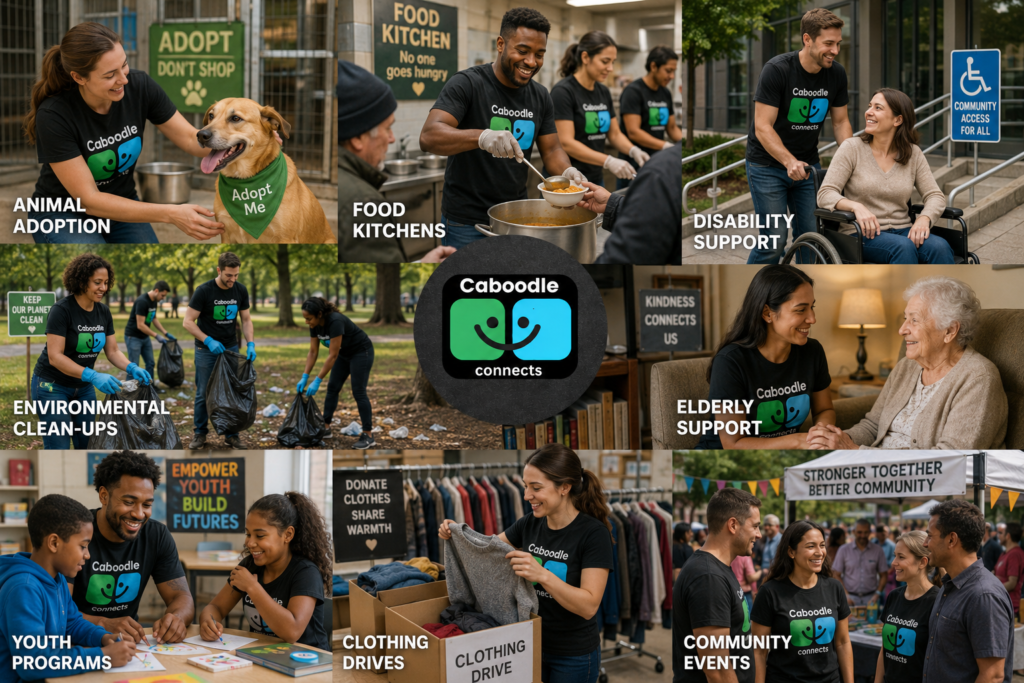
And that is one of the central ideas behind Caboodle Connects: connecting business activity with the wider community so that commercial success can help generate wider opportunity.
7. Scale the Impact — Not Just the Revenue
Growth is important.
But social entrepreneurs should ask a bigger question than:
How much money can we make?
Ask:
How much positive impact can we create sustainably?
That doesn’t mean ignoring profit.
Quite the opposite.
A profitable business has more capacity to invest, employ, innovate, expand and increase its impact.
The objective is therefore not profit instead of purpose.
It is:
Profit that enables purpose.
What Skills Does a Social Entrepreneur Need?
You don’t need to be an expert in everything.
But successful social entrepreneurs typically develop a combination of entrepreneurial and social-impact skills.
Business Skills
Understanding customers, marketing, sales, finance, operations and strategy.
Communication Skills
Being able to explain your mission clearly to customers, partners, investors and your community.
Problem-Solving
Seeing opportunities where others see obstacles.
Leadership
Bringing people together around a shared objective.
Financial Thinking
Understanding that a sustainable business needs healthy economics.
Empathy
Understanding the people and communities affected by the problem you’re trying to solve.
Adaptability
Being willing to change the idea when evidence shows that something isn’t working.
These skills can be learned.
You don’t have to start with all of them.
Can You Become a Social Entrepreneur Without a Lot of Money?
Yes.
One of the biggest misconceptions about entrepreneurship is that you need substantial capital before you can begin.
Many social enterprises can start small.
You might begin with:
A service rather than a physical product
Your existing professional skills
A digital business
Consulting or mentoring
A local community service
A marketplace
An education platform
A technology solution
A cooperative business
A partnership with an existing organisation
The key question isn’t always:
How much money do I have?
It can be:
What resources, skills, relationships and knowledge do I already have?
Your first business doesn’t have to be your final business.
It needs to be a starting point.
Social Entrepreneurship Business Ideas
There are almost unlimited possibilities for social entrepreneurship.
The right opportunity depends on the problem you understand and the community you want to serve.
Potential areas include:
Supporting local small businesses
Employment and skills development
Education and mentoring
Sustainable products
Recycling and circular economy businesses
Community marketplaces
Affordable services
Digital inclusion
Support for women entrepreneurs
Youth entrepreneurship
Local food businesses
Community tourism
Social housing solutions
Technology for social good
Cooperative businesses
The strongest idea is not necessarily the most fashionable.
It is the one where you understand the problem deeply enough to create a solution that people genuinely value.
Examples of Social Entrepreneurship
Social entrepreneurship can take many different forms.
Some businesses build their entire model around a social mission. Others incorporate a social purpose into an established commercial business.
The common thread is the deliberate creation of social value alongside economic value.
This is important because there is no single template for becoming a social entrepreneur.
You don’t have to copy someone else’s business.
You need to discover your problem, your solution, your market and your impact model.
What Is the Difference Between a Social Enterprise and a Charity?
A charity and a social enterprise can both address social problems, but they are not necessarily structured in the same way.
A charity generally exists primarily to pursue a charitable purpose and may rely heavily on donations, grants or fundraising.
A social enterprise uses entrepreneurial activity to generate revenue while pursuing a social or environmental purpose.
There can also be significant overlap.
Some organisations combine charitable activities with trading activities.
The important distinction for an aspiring social entrepreneur is to understand how your organisation will generate enough income to remain financially sustainable while delivering its mission.
The Sociopreneur Approach: Profit With Purpose
This is where my own philosophy differs slightly from simply describing someone as a social entrepreneur.
I use the term Sociopreneur to describe a mindset as much as a business structure.
A Sociopreneur doesn’t see commercial success and community benefit as competing objectives.
They ask:
How can the business succeed because it creates value for others?
That question changes the way you think about entrepreneurship.
Instead of seeing customers purely as buyers, you see relationships.
Instead of seeing communities purely as markets, you see ecosystems.
Instead of seeing profit as the final destination, you see it as one of the resources that can help the business continue creating value.
That is the thinking behind The Sociopreneur Method.
The Future of Entrepreneurship May Be More Social
Business is changing.
Consumers increasingly want to understand what companies stand for.
Employees want meaningful work.
Communities want stronger local economies.
Entrepreneurs want independence without necessarily sacrificing their values.
Technology is making it easier for individuals and small teams to create businesses, reach customers and build communities without the infrastructure that previous generations needed.
That creates an enormous opportunity.
The next generation of entrepreneurs doesn’t necessarily have to choose between business success and social impact.
They can design businesses where the two reinforce each other.
Start With One Problem
You don’t need to have the perfect business idea today.
Start with a problem.
Find the people experiencing it.
Listen to them.
Understand what they need.
Design a solution.
Find someone willing to pay for that solution.
Test it.
Measure the impact.
Improve it.
Then grow it.
That is entrepreneurship.
When you deliberately build social or community value into that process, you begin moving towards social entrepreneurship.
And when you combine commercial sustainability, social impact and a community-first mindset, you are entering what I call the world of the Sociopreneur.
Continue Your Sociopreneur Journey
If you’re ready to explore the subject further, these guides take you deeper into the key areas of social entrepreneurship:
What Is a Social Entrepreneur?
Understand the meaning of social entrepreneurship and what separates a social entrepreneur from a conventional entrepreneur.
Social Entrepreneur vs Entrepreneur
Explore the similarities, differences and different approaches to building a purpose-driven business.
How to Start a Social Enterprise
A practical guide to turning a social problem into a commercially sustainable enterprise.
Examples of Successful Social Entrepreneurs
Explore examples of entrepreneurs who have combined business with social or environmental impact.
Social Entrepreneurship Business Ideas
Discover potential business opportunities where commercial value and social purpose can work together.
Ready to Become a Social Entrepreneur?
You don’t need to wait for someone to give you permission.
You need a problem worth solving, the courage to start and a business model capable of sustaining the mission.
Build the business. Create the impact. Make the profit purposeful.
Welcome to the Sociopreneur journey.